SOFTWARE


With the increase in power demand, backup power solutions have become more critical than ever, ensuring uninterrupted operations during outages and stabilizing grid fluctuations. As industries and infrastructure grow more dependent on continuous power, manufacturers are adopting two primary approaches: some aim to integrate their products into existing systems, while others focus on designing complex, reliable, standalone units capable of uninterrupted performance.
When integrating with an existing system, it is essential to determine the compatibility of electrical interfaces, load profiles, and structural integrity under varying load conditions. From a structural perspective, the major concerns include safety and mechanical mounting.
Conversely, when designing a new system, manufacturers must evaluate the dynamic response from the component level to the full assembly under diverse load conditions. This includes analyzing structural behavior during transportation and commissioning. The goal is to optimize the design to meet applicable standards and minimize potential damage.
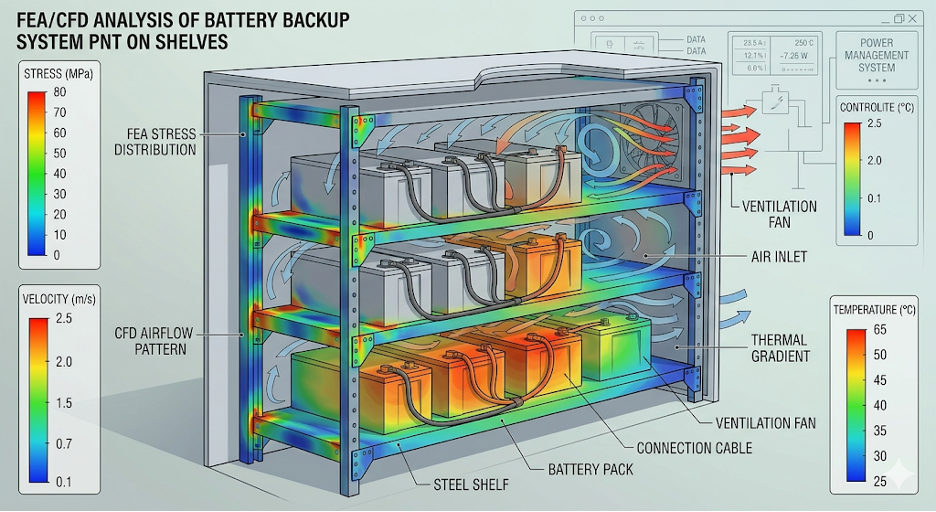
To evaluate both scenarios, Finite Element Analysis (FEA) has proven highly effective. It not only reduces testing time and cost but also accelerates the product’s time-to-market. This method enables simulation of real-world conditions, allowing stress in multiple components to be assessed under various loading scenarios. Computational Fluid Dynamics (CFD) further assists in analyzing fluid flow, heat transfer, and pressure distribution in and around the system, offering a strategic advantage in product design and optimization.
Evaluating system performance, maintenance requirements, environmental resilience, and structural integrity is crucial. The geographical location of installation plays a significant role, as factors such as temperature extremes, humidity, and altitude can greatly influence system efficiency and longevity.
When discussing structural integrity, it is important to evaluate the system under different scenarios. During transportation, heavy systems must be analyzed for their structural behavior under random vibration responses caused by suspension systems, wheels/tires, rigid body structures, and road roughness. Once installed at a specific site, the system must be evaluated for shock response, commonly referred to as response spectra analysis.
For evaluating packaging and products during transportation, the relevant ASTM standards are used. These standards outline a testing workflow to replicate vibration conditions a system may encounter during transit, allowing engineers to assess dynamic response and evaluate potential damage. Damage is measured by the displacement and stress induced by vibrations transmitted from the vehicle bed, which can compromise structural integrity and functional reliability.
During the installed state, the ASCE Hazard Report for the specific site is used. These reports may include data such as spectral acceleration values, site class, shock design category, and mapped ground motion parameters.
In random vibration response analysis, both input excitations and output responses, such as displacements and stresses, are statistical in nature. The values obtained are not absolute; rather, they imply that for a given excitation load, the displacement and stress in a component will remain below a certain threshold. Thus, the inputs required for solving random vibration response are the model’s natural frequencies and Power Spectral Density (PSD) data.
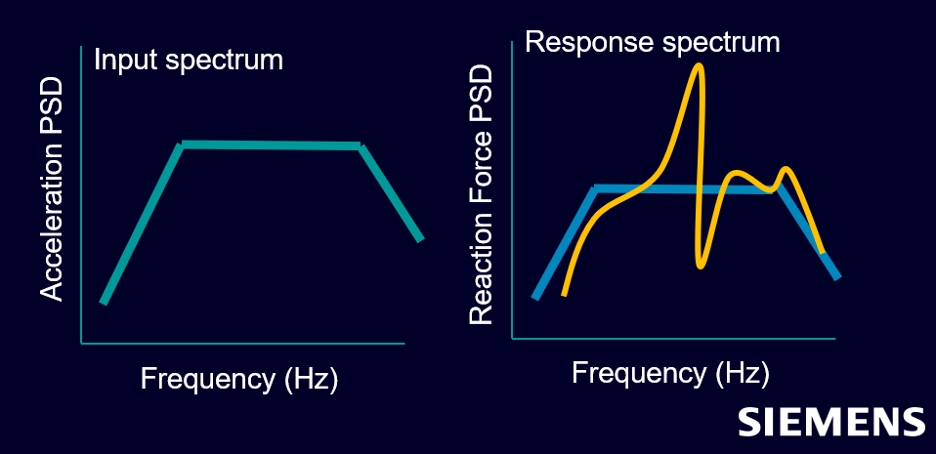
Model’s natural frequencies are determined through modal analysis, while the PSD profile is constructed by averaging individual time-history acceleration events. A larger area under the PSD curve implies greater energy absorption in that frequency band, leading to amplified system response and higher displacement. As a manufacturer, the key aim is to reduce energy transmission by implementing effective damping and designing the model so that its natural frequency avoids the high-energy zones with in the PSD spectrum.
Shock response, on the other hand, is a short-duration transient phenomenon that can cause part malfunction, stress development, and fracture. Responses from a response spectra analysis are deterministic meaning that for a given excitation, the maximum response is calculated based on the input shock response spectrum and the method used to combine modal responses. Inputs for shock response analysis include the Shock Response Spectrum (SRS) profile and the frequency range of interest.

By performing both random vibration and shock response analyses, engineers gain a comprehensive understanding of the system’s structural behavior and can accurately estimate potential failure locations.
Certified engineers at Designfusion can perform such complex simulations for companies in the aerospace, mechanical, and heavy machinery industries. Along with advanced simulations, we can help organizations with their design optimization and 3D printing needs.
We are here to help – feel free to reach out anytime!

Lohith Porwal is an Application Specialist and has over 7 years of experience as a CAE analyst. He has been with Designfusion since October 2024, supporting Siemens CAE tools. His main focus is developing workflows and providing support on live projects.