SOFTWARE


In simulations, we have always solved the flow physics over an aircraft wing by treating it as a rigid structure; in reality, it is flexible. They are deliberately designed to be flexible, i.e., to bend and deform under aerodynamic loads to provide passenger comfort by absorbing shock from turbulence, to achieve higher aerodynamic performance, and to ensure structural safety.
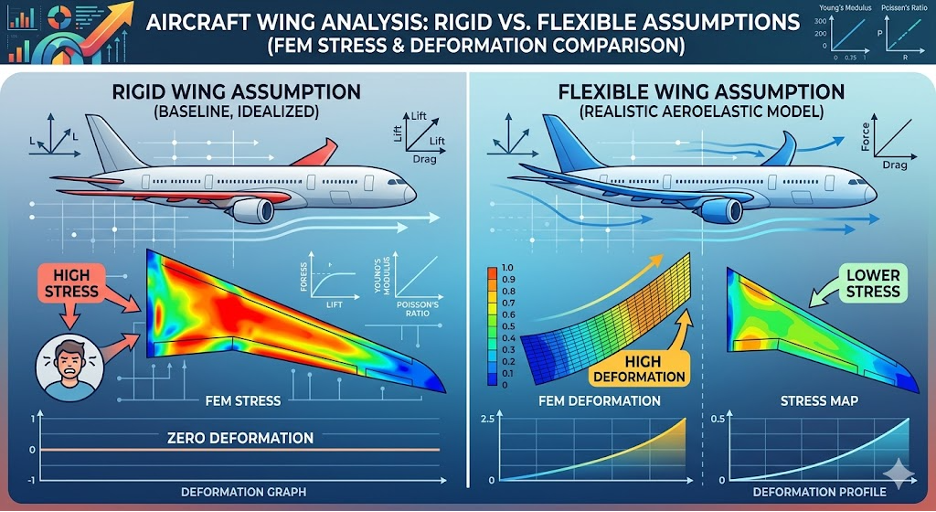
The wings act as a shock absorber; they bend to dissipate energy from turbulence and gusts. By bending, the incoming air experiences a different angle of attack, which leads to the generation of tiny trailing vortices, some of which is additional lift caused by the gust. The elastic potential energy stored within is then released by slowly oscillating back to its original shape.
Due to the flexibility, the distribution of aerodynamic load is more even across the wing structure, resulting in reduced high stress concentrations at the wing-fuselage joint. Thus, extending the aircraft’s lifespan by reducing structural fatigue. The aerodynamic load is generated by the pressure differences. This load is nonlinear and mainly depends on the dynamic factors like air speed, angle of attack, and air density. However, mechanical forces are applied at specific locations or uniformly along a member.
From the above context, the technical team at Designfusion has firmly established the concept of aeroelasticity. It is the branch of physics and engineering that studies the interactions between inertial, elastic, and aerodynamic forces that arise when an elastic body is exposed to fluid flow. The system is continuously in a feedback loop where airflow over the flexible object causes it to bend or vibrate, which then changes the airflow over the object. This is an unstable state for an aircraft.
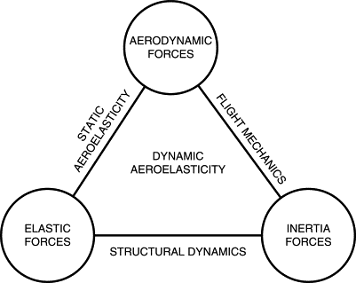
If an aircraft needs to stabilize again, the damping of the external aerodynamic forces must be achieved. It comes from three main sources:
1. Aerodynamic Damping
2. Structural Damping
3. Mass balancing
Aerodynamic damping acts as a fluid cushion where the air resists the structure's motion; structural damping dissipates energy as heat through internal material friction and joint movement; and mass balancing strategically shifts the center of gravity (often using lead weights) to ensure inertial forces counteract aerodynamic twisting. Together, these factors ensure that the energy lost during a vibration exceeds the energy gained from the airflow, keeping the feedback loop stable.
There are different solution types available to account for all three forces to understand and predict the overall behavior of the aircraft system.
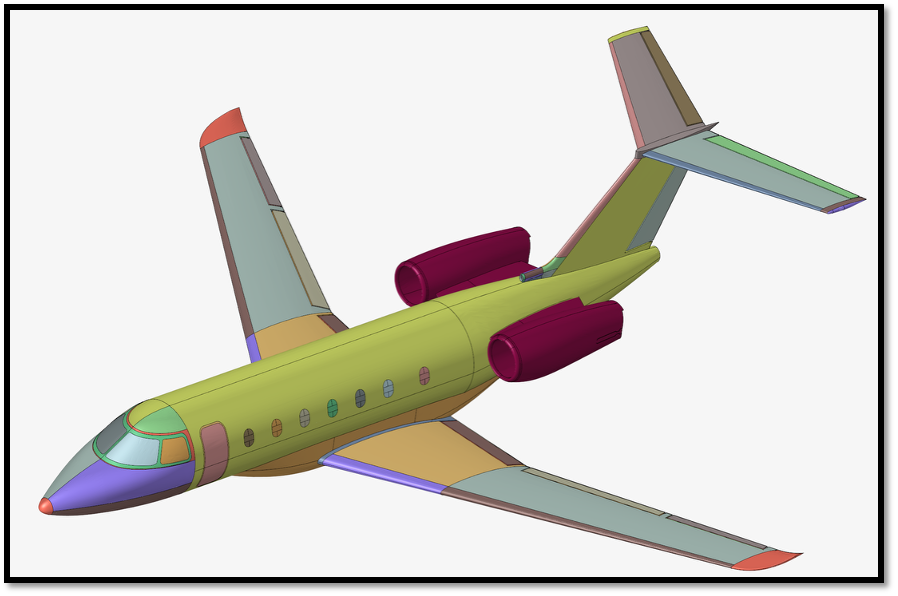
To perform the aeroelastic simulation for the aircraft model, Designfusion will use the model that has parts/systems present:
All the parts listed above play a crucial role in obtaining the aircraft's behavior.
For our upcoming blogs, certified engineers at Designfusion will simulate the case study model for each aeroelasticity solution type and discuss the results.
To simulate such complex models and interpret the results, our engineers are ready to help you.
Feel free to reach out to us.

Lohith Porwal is an Application Specialist and has over 7 years of experience as a CAE analyst. He has been with Designfusion since October 2024, supporting Siemens CAE tools. His main focus is developing workflows and providing support on live projects.